The Warm Towel Illusion: What a Heated Rail Really Does in a British Bathroom
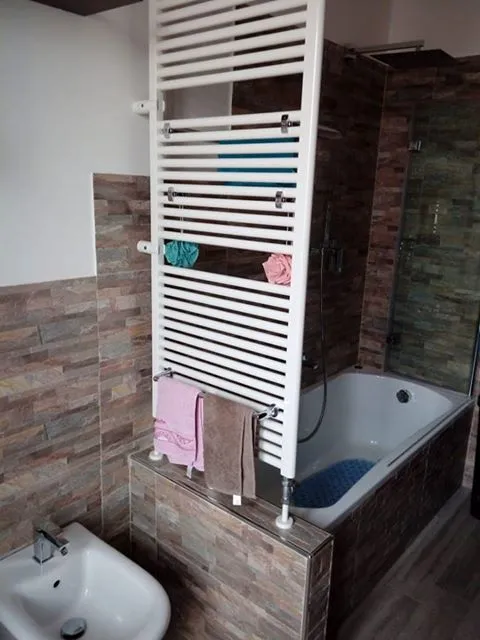
Photo: MB SRL, CC BY 4.0, via Wikimedia Commons
A heated towel rail is one of those bathroom fittings that sounds more capable than it is. It's called a towel rail, it gets warm, and it lives in the bathroom. Surely it dries towels? Not really. It warms them, takes the edge off a cold morning and makes a small room feel less like a utility cupboard. But if you expect it to dry a family's bath towels in a steamy British bathroom, you'll spend a lot of time touching damp fabric and wondering why.
What a heated rail actually does
At its simplest, it warms the towel. It raises the surface temperature of the fabric, which helps a bit with evaporation. It also makes the room feel less grim when you step out of the shower. But it doesn't move much air, and it doesn't create the kind of controlled heat and airflow you get in a proper drying cabinet.
Most domestic rails are modest heaters. Think a few hundred watts, not a tumble dryer. A central-heating rail only heats when the heating is on; an electric one can run in summer but costs money to leave on. So the towel gets warm. Warm is not dry.
Heat isn't the same as drying
Drying is a three-part job: heat, airflow and surface area. A rail gives you some heat and a fixed amount of surface area. It gives you almost no airflow unless the bathroom itself is ventilated. If the air around the towel is already humid, the moisture has nowhere to go. You're just moving damp around and calling it progress.
This is why a towel can feel hot and clammy at the same time. The rail is warming the water in the fabric as much as the fabric itself. A warm damp towel is not a dry towel; it's a towel with a better attitude.
Why your towels still feel clammy
Usually it's one of four things. The towel is bunched up, so the damp middle never gets any air. The bathroom has no effective extraction, so steam hangs around after a shower. The rail is packed with towels like a deckchair, which blocks the gaps between bars. Or the towels are simply too thick and too big for the rail and the room.
There's also the central-heating problem: in summer, the rail is cold; in winter, it's only hot when the heating is on. If your bathroom is the coldest room in the house, the towel is fighting a losing battle. An electric rail can help in summer, but only if you actually run it long enough to do something useful.
The layout problem in small bathrooms
In a small UK bathroom, the rail is often squeezed into the only free wall, usually above the radiator or next to the shower. That's understandable, but it matters. A rail that's too close to the shower gets hit by spray. A rail behind the door gets no airflow. A rail with towels layered over every bar is basically a towel shelf with delusions.
Give each towel room. Hang bath towels so they drape over two bars with a gap in the middle, not folded into a thick pad. If the rail is small, dry one towel at a time and rotate. Use hooks for bathrobes, not wet towels. And if the rail is jammed against a wall with no gap behind it, the back of the towel will stay damp while the front feels lovely and warm.
Practical fixes that make a difference
First, run the extractor fan during and after every shower. If you don't have one, open a window briefly — yes, even in November — and shut the bathroom door so moisture doesn't spread through the house. Second, wring towels properly before hanging. Not bone-dry, just not dripping. Third, leave space between towels on the rail. Fourth, check the rail is actually working: bleed a central-heating rail, check the thermostat, and don't expect an electric rail to dry a bath sheet on a timer that runs for twenty minutes.
If your rail is only warm at the top, it may need balancing or bleeding. If it's an electric model, a longer low setting is often better than a short blast. And consider the towel itself. A lighter, quick-drying towel will do better on a rail than a heavy 700 GSM bath sheet. That's not a reason to buy poor-quality towels; it's a reason to match the towel to the bathroom.
Treat it as a warmer, not a dryer
None of this means heated towel rails are pointless. They're lovely. They take the shock out of a cold towel and make a small bathroom feel less utilitarian. But if you expect one to dry a family's bath towels in a steamy room with the window shut, you'll be disappointed.
Use the rail for warmth and finish-drying, not for drying a soaked towel from scratch. Get the ventilation right, give the towels space, and be honest about what a few hundred watts can do. A warm towel is a small luxury. A dry towel is a plumbing and airflow problem. Solve the second and the first takes care of itself.