How to Tell a Good Towel in the Shop Without Reading the Label

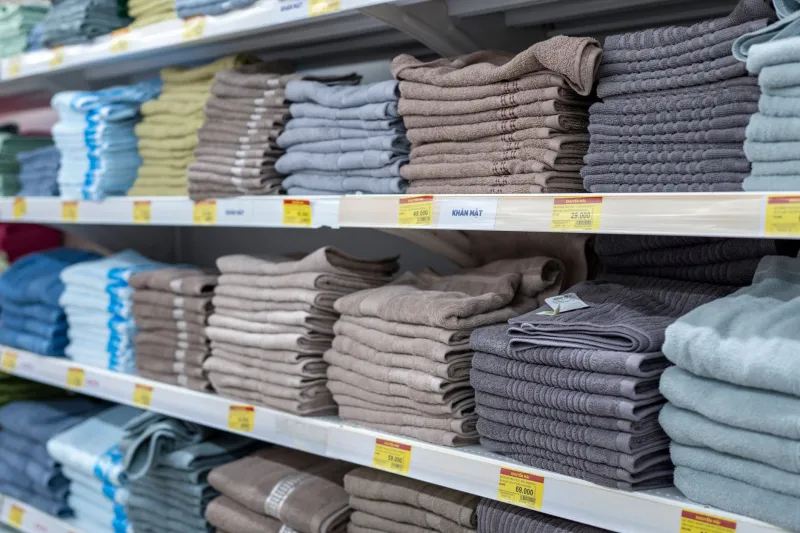
Photo: person feeling towel fabric in homeware shop UK, via get.pxhere.com
Walk into any homeware department and the labels start talking. GSM this, hotel-quality that, 'ultimate softness' in a font that looks like it cost more than the towel. A towel is a simple thing: loops of cotton, bamboo or microfibre, a hem and a bit of weaving. The label makes it sound like a space programme.
The useful question isn't 'what is the GSM?' It's 'will this dry me, survive my washing machine and still feel decent in six months?' You can answer a lot of that in half a minute, without trusting a single swing tag.
Start with your hands, not the swing tag
Pick up the towel. Don't stroke the top fold. Open it out and feel it with dry hands. It should feel clean, dry and slightly springy, not clammy or coated. Some shop towels are finished with sizing to make them feel crisp on display; that's not the same as quality. If it feels stiff as cardboard or slippery as a chip shop wrapper, put it back.
Also check the fibre content now, not at the till. A towel that's mostly polyester will feel different after a few washes, and a 'bamboo' towel may be a blend. There's nothing wrong with a blend if you know what you're buying. There is something wrong with paying pure-cotton money for a towel that's mostly plastic.
The squeeze and twist
Grab a corner and squeeze. Then twist it like you're wringing out a flannel. A well-made towel should feel springy, not spongy. When you release, it should bounce back. If it stays twisted or feels limp, the yarn twist is loose and it'll likely mat, shed and generally look tired before its time.
Do this on a corner, not the middle of the display towel, to avoid stretching the thing you're about to buy. A good towel can take a bit of handling. A bad one gives the game away immediately.
Look at the pile, not the plushness
Rub your palm across the surface. Loose fibres on your hand? That's a warning. Deep, dense pile feels luxurious in the shop, but in a UK bathroom it can hold water and take ages to dry. A moderate pile with visible, tight loops is often the better everyday towel. It'll dry faster on a rail or radiator and won't feel like a wet duvet after one shower.
Check both sides. A towel that's smooth on one side and fluffy on the other may be a different construction; fine, but know what you're buying. Run your fingers along the loops. If they snag easily or look uneven, the towel will do the same after a few washes.
Hems, edges and the tug test
Find the hem. Tug gently along the seam. Look for small, tight stitches and a folded edge that lies flat. If the hem is glued, puckered or has loose threads, it'll be the first thing to go in the wash. Check the side edges too. A towel that curls up like a crisp packet after one wash started life with a weak edge.
This is the boring bit, but it's where cheap towels fail first. A towel can feel lovely and still fall apart at the borders. If the hem looks like it was sewn by someone in a hurry on a Friday afternoon, walk on.
Weight is a clue, not a verdict
A heavy towel feels reassuring, but weight alone doesn't mean quality. A big bath sheet can weigh more than a smaller bath towel simply because there's more fabric. Compare like with like. Lift a folded towel and judge how it feels for its size. If it's heavy and stiff, it may take an age to dry. If it's light and thin, check the twist and pile — it might still be a good quick-dry towel.
GSM is grams per square metre, and it's useful context, not a score. A 500 GSM towel can be better than a 700 GSM one if the yarn and weave are right. Don't let a big number on the label do the thinking for you.
The shop-specific traps
John Lewis lighting makes everything look softer, so take the towel to a window if you can. Dunelm's stacks are often tied with ribbon, so open the bundle and check the inside fold. TK Maxx is a treasure hunt: check for missing labels, random sizes and 'made for outlet' quality. Hotel-supply sales can be brilliant value, but institutional towels are often flat, rough and built for industrial laundering — fine if that's what you want, not if you want a soft bath sheet.
Also check the wash label. If it says dry clean only on a bath towel, put it down. You're buying a towel, not a museum piece.
The 30-second routine
Squeeze, twist, rub, tug, lift. That's it. If the towel passes those five, check the price and the return policy. If it fails one, don't talk yourself into it because the colour matches your bathroom.
Buy one first if you're unsure. A towel is a cheap experiment compared with retiling. And remember: the best towel in the shop is the one that will still feel decent after a British winter of washing, hard water and a radiator that never quite gets hot enough.