Give Your Bath Towel Some Air: Choosing a Hanging Spot That Works

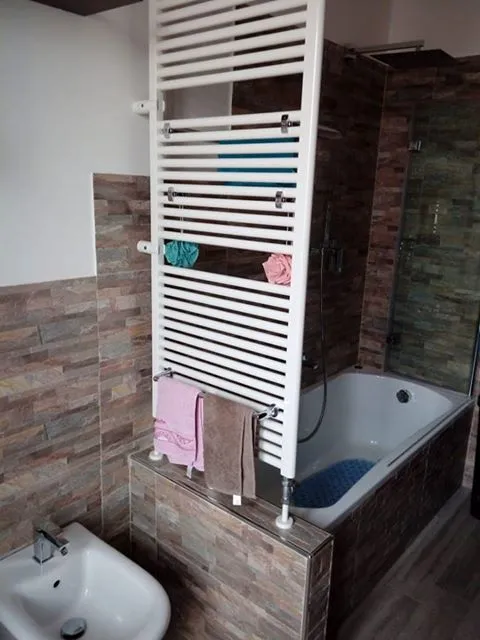
Photo: bath towel hanging on heated towel rail in small British bathroom, via honestlywtf.com
Most British bathrooms give a bath towel very little choice. It ends up on the nearest hook, over the shower screen, or draped across the radiator because that is the only clear space going. But where a towel lives has a real effect on how quickly it dries, how it wears and whether your bathroom starts to feel damp and fusty. The right answer is not always the most convenient one.
Why airflow matters more than heat
Drying is mostly about moving moisture away from the fabric. Heat helps, but air movement does the heavy lifting. A towel bunched up on a hook can stay damp in the middle for hours, even in a warm room. A towel spread out where air can pass over both sides will dry far more reliably.
This is why the nearest radiator is not automatically the best spot. A warm towel feels lovely, but heat can dry the outer surface while the inner folds stay clammy. In a small bathroom with no window and a weak extractor fan, that moisture has nowhere to go. You end up with a towel that smells faintly of damp before wash day and a bathroom that feels muggy long after the shower has finished.
The hook: handy, compact and often the worst for drying
A hook is brilliant for a dressing gown, a hand towel or a towel that will go straight in the wash. For a full-size bath towel, it is usually the least effective option. Fold a large towel over a single hook and you create several layers of damp fabric pressed together. The bottom hem and the middle section stay wet longest.
That does not make hooks useless. In a rented flat where drilling is off the cards, an over-door hook or a well-placed adhesive hook may be the only practical choice. If you use one, try to spread the towel rather than bundling it up. Two hooks spaced apart are better than one. A hook with a longer arm gives the towel a bit more breathing room. Avoid hanging a wet towel on the back of a closed door, because the door traps the damp air against it.
The bar: simple, space-efficient and better than it looks
A fixed towel bar is the quiet workhorse of the bathroom. It lets you drape a towel so that air can reach both sides, and it takes up far less room than a rail. The catch is that many bars sit too close to the wall. If the towel is pressed flat against tiles, the wall side stays cold and damp while the room side dries. Look for a bar that holds the towel slightly away from the wall, or accept that you need to leave a gap by folding the towel loosely.
Bars suit small bathrooms well because they can be mounted higher up, out of the way of doors and elbows. They are also easy to wipe down. The main wear issue is the fold line. If you always hang a towel over the same bar in the same way, that crease takes a beating. Rotate the towel and change where it folds. In a rental, look for tension-mounted bars or over-cabinet fittings before reaching for the drill.
The rail: best for airflow if you have the wall space
A ladder-style towel rail gives you several bars and good air circulation, which makes it the strongest option for drying a bath towel properly. An unheated rail is essentially a set of well-spaced bars and works well in a ventilated bathroom. A heated rail adds warmth, which can speed drying, but it is not a magic fix. A wet towel on a heated rail still puts moisture into the air. If the extractor fan is poor or the window stays shut, that moisture will settle somewhere else.
Heated rails are also not a substitute for ventilation. Run the fan during and after a shower, open a window if you have one, and leave the bathroom door ajar once the room has cleared. Constant high heat is not especially kind to any towel over the long term, and it can make fibres feel stiff if the towel is repeatedly dried too aggressively. Use the rail as part of a drying routine, not as the only thing standing between your towel and a musty smell.
Matching the spot to the room
In a small bathroom, prioritise airflow over convenience. A compact bar mounted high on a wall, or a slim rail above the door, can work better than a hook behind the door. Keep the towel away from the toilet if you can, and make sure it is not blocking the extractor or the window. If space is really tight, a freestanding rail that moves out of the way may be the most sensible answer.
In a rented flat, avoid permanent fixes unless you have permission. Over-door hooks, freestanding rails and removable bars are all landlord-friendly. Suction hooks can work on smooth tiles but often fail in a steamy bathroom, so do not trust them with a heavy wet towel. Check that any plug-in heated rail is suitable for bathroom use and positioned well away from the bath and shower.
In a family bathroom, the biggest problem is usually volume. Four people sharing one hook is a recipe for damp towels and frayed tempers. Give each person a distinct spot, whether that is a named hook, a section of rail or a bar. Wash towels regularly and do not let them sit in a heap on the floor between uses. A towel that never gets a chance to dry will smell before it wears out.
The simple rule
A bath towel needs to be spread out, not scrunched up, and it needs air on both sides. If it is still damp several hours after use, or it smells musty before it is due for a wash, the hanging spot is wrong. Move it, loosen the fold, improve the ventilation or wash it more often. The best spot is not the prettiest one. It is the one that lets the towel dry properly without turning your bathroom into a damp room.