No Drill, No Drama: How Renters Keep Bath Towels Fresh in a Landlord's Bathroom
Photo: Federal Bureau of Investigation, Public domain, via Wikimedia Commons
Renting puts a fence around your towel routine. No drilling means no proper rail. No rail means the towel lives on the back of the door, which means it never really dries, which means by Thursday it smells like a swimming pool changing room. Add a shared bathroom and an extractor fan that's been wheezing since 2019 and you've got a problem that feels structural.
It isn't, though. Most of what keeps a towel fresh is air, timing and rotation — none of which need a landlord's permission. You just have to be a bit more deliberate than someone with a chrome ladder rail and a south-facing utility room.
Start with the towel, not the bathroom
If you're renting, buy for the room you've actually got rather than the bathroom you'd like. That means a mid-weight towel — somewhere around 500–600gsm — rather than the thick, heavy hotel-style ones. A chunky 700gsm bath sheet holds a huge amount of water and, in a steamy internal bathroom with nowhere to hang it properly, it will still be damp the next morning. Light and quick-drying beats plush and waterlogged.
A useful trick: buy two towels of the same size rather than one expensive one. Rotation does more for freshness than fabric quality ever will, and two mid-range towels cost about the same as one aspirational one.
The rotation, not the rule of three
Most towel advice assumes a heated rail and a cupboard full of spares. Renters usually have neither, plus a flatmate who thinks a towel is clean until it stands up on its own.
A workable renter's system:
- Two bath towels per person in active use. One on the go, one clean and waiting.
- Three to four uses per towel if your bathroom ventilates at all. Two to three if it doesn't.
- Swap on a fixed day, not when you notice a smell. Sunday and Wednesday, or whatever suits. Smell is the last warning, not the first.
- Hand towels are different. Those get two days, maximum, in a shared bathroom. They're the most-touched textile in the flat and the least likely to get washed.
If you're in a house share, this only works if everyone's on the same rhythm. A cheap wire basket per person, labelled with a marker pen, does more for household harmony than any amount of polite hinting.
Hanging things without touching the walls
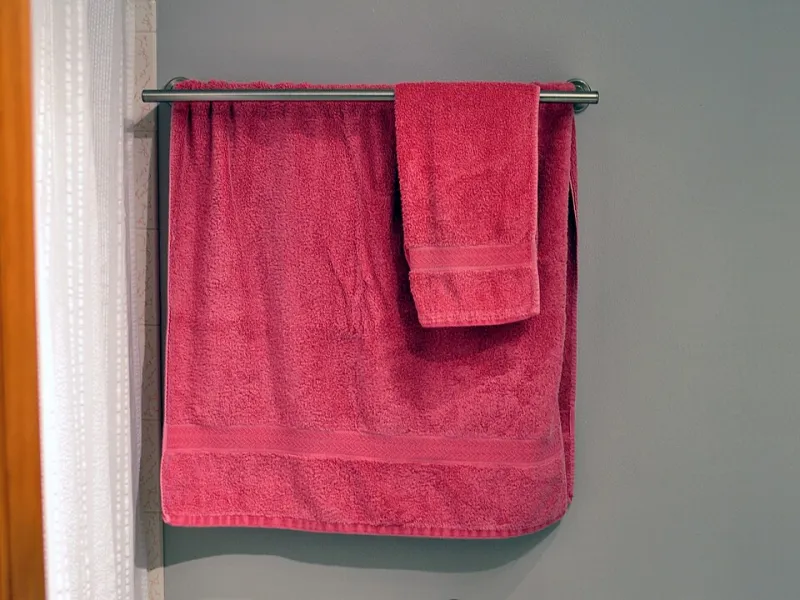
The best renter-friendly drying spot isn't in the bathroom at all. It's wherever there's moving air — a bedroom with the window cracked, a hallway, the back of a door in a room you actually heat. Towels dry by evaporation, and a bathroom that's just been used is the worst place in the flat for that.
Kit that comes off without leaving a mark:
- Over-door hooks. Cheap, no fixings, and they get the towel spread out rather than bunched. Spread is everything — a towel folded over itself in the middle dries at a quarter of the speed.
- Suction cup hooks on tiles. Genuinely reliable on clean, smooth tile. Useless on painted plaster or grout lines, so check before you buy.
- A tension rod across a window recess or alcove. No screws, no marks, and it holds a towel at full width.
- A folding clothes airer in the spare room or hallway. Not glamorous, but it is the single biggest upgrade most renters can make.
- Adhesive strips rated for the weight. Fine for a light towel ring. Read the removal instructions before you stick one on, because the deposit is the thing you're protecting.
What you should avoid: the classic over-the-radiator drape in winter. It dries the towel, sort of, but it blocks your heating and the towel ends up stiff. And never leave a towel bunched on a door handle overnight — that's how you grow the smell in the first place.
The extractor fan you can't replace
You can't fit a new fan, but you can stop working against the one you've got. Run it during the shower and for a good ten to fifteen minutes afterwards — most people switch it off the moment they leave the room, which is exactly when the moisture is still in the air. If it's a pull-cord model with a timer, use the timer.
Then give the room a fighting chance: crack a window even in November, leave the door open once you're dressed, wipe the walls down if they're running, and squeegee the shower screen. Every bit of water you remove from surfaces is water that doesn't end up in your towel.
A small dehumidifier is the other option, and in a flat with an internal bathroom it's often the difference between a towel that's fine and a towel that's sour. A compact 10–12 litre model will pull a surprising amount out of a small bathroom in an hour. Run it after showers rather than all day.
Wash timing when there's no airing cupboard
Without somewhere warm to store clean towels, don't build up a stockpile. Wash two or three at a time, more often, rather than one big load a fortnight. A clean towel folded into a damp-ish cupboard picks up that musty edge within days — it's the cupboard, not the wash.
If your only storage is a shelf in a cold bathroom, keep clean towels somewhere else entirely. Under the bed in a cotton bag beats a bathroom shelf every time.
The wash itself
Renters often share machines, which makes overloading tempting. Don't. A drum crammed with towels and bedding doesn't rinse properly, and detergent residue is a major cause of that stale, slightly greasy smell people blame on the bathroom.
- 40°C, normal cycle. Hotter isn't automatically cleaner and it wears the fibres out faster.
- Less detergent than the bottle says. Roughly two-thirds of the recommended dose for a towel load.
- No fabric conditioner. It coats the fibres and kills absorbency. If your towels feel harsh, that's usually a drying problem, not a softener problem.
- Half a cup of white vinegar in the softener drawer every few washes to shift detergent build-up. It won't leave a smell once dry.
- Dry fully before folding. Even slightly damp folding undoes the whole wash.
The good news for renters: hard water is the usual culprit behind stiff towels, and it's the same in a bought flat as a rented one. A cooler, leaner wash plus proper drying handles most of it.
The bit people forget
Before you hand the keys back, wash everything, dry it thoroughly and put it away dry. Towels left in a airless bathroom for the final fortnight of a tenancy are how you end up with a mould question at the deposit stage — and "fair wear and tear" won't cover a towel you left damp on a shelf.
None of this is glamorous. But a renter's towel routine that actually holds up is mostly about moving air, spreading towels out and swapping them on a schedule. The bathroom you can't touch is only half the story.