Soft Isn't Absorbent: The Conditioner Habit That's Quietly Ruining Your Towels
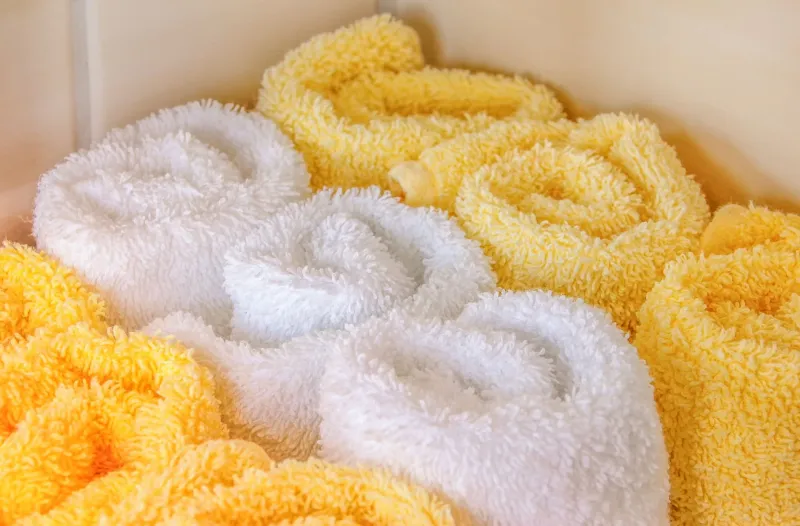
There's a particular kind of disappointment that only happens in a bathroom. You've just stepped out of the shower, you reach for a towel that felt lovely and plush on the airer, you wrap it round yourself — and thirty seconds later you're still wet, standing in a slightly cold puddle of your own making. The towel isn't dirty. It's not worn out. It's just been conditioned into uselessness.
This is the fabric softener trap, and it's one of the most common towel problems we hear about in British homes. It's also one of the easiest to fix, provided you're honest about what's been going into your machine.
The softness you can feel isn't the softness you want
Cotton works because of its loops. Every one of those little terry loops is a bundle of fibres with a natural thirst for water — they wick moisture off your skin and hold it until you hang the towel up. Anything that sits on the surface of those fibres, or coats them in a film, gets in the way of that job.
Fabric conditioner is, functionally, a film. It's built on surfactants with a positive charge that cling to the negatively charged cotton, plus silicones, waxes and perfume oils that smooth the fibre down. That smoothing is exactly what makes a towel feel soft in the shop or straight off the airer. It's also what makes it slick, slightly water-repellent, and slow to take anything up.
So you end up with a towel that scores brilliantly on the hand-feel test and badly on the actual point of a towel. That's not a manufacturing fault. You've paid for softness twice and absorbency not at all.
Why it gets worse rather than better
One wash with conditioner is a light coating. Fifteen washes is a crust.
Because conditioner is designed to stay behind on the fabric, each wash adds another layer on top of the last. On bedding and clothing that's mostly harmless — everything gets washed and worn and the build-up cycles through. Towels are different. They're washed more often, at lower temperatures in most UK homes, and rinsed in water that in large parts of the country is doing its own bit of damage.
Two things accelerate the problem. First, low-temperature eco washes are great for energy bills and rubbish at shifting waxy residue, because the stuff softener leaves behind often needs warmth to properly rinse away. Second, over-dosing. Conditioner is dosed by the cap, the cap is generous, and a full load of towels is not the same as a full load of mixed laundry. Ladle in a capful for a small towel wash and you've effectively doubled the concentration.
The whiff nobody blames the softener for
Here's the bit that surprises people. A towel that smells faintly musty two days after washing is often not a mould problem at all — it's a coated towel problem.
A slick, water-repellent surface takes longer to dry. A towel that takes longer to dry spends more hours damp. Damp cotton plus a trapped layer of perfume oils, body oils and detergent residue is a decent approximation of a petri dish, and the result is that sour, closed-in smell that fabric conditioner is supposed to prevent and actually helps create.
The tell is straightforward. If your towels smell fine straight out of the machine and grim by Thursday, and they also feel slightly slick rather than fluffy, you're looking at build-up rather than bacteria in the drum.
The routine that gets absorbency back
Start with the simplest possible change: stop using fabric conditioner on towels. Not reduce — stop. Towels, bath mats, flannels, the lot. Use it on your jumpers if you like; keep it away from anything whose job is to take water off a human being.
Then adjust the wash itself:
- Use less detergent than you think. Liquid detergent for a towel load, roughly two-thirds of the recommended dose, is plenty. Excess detergent leaves its own residue.
- Give it a warm wash. A 40°C cycle for towels is not reckless, and it rinses far more effectively than a 20°C eco programme. Save the cool washes for clothes you're trying to protect.
- Add an extra rinse. Most UK machines have a button for it. Use it on towel loads.
- Dry properly. Shake the towel out before hanging — snapping the fibres apart makes a real difference — and give it air movement rather than a tight fold over a rail. If you use a tumble dryer, wool dryer balls do more for fluffiness than any bottle on the shelf.
The vinegar rinse, done sensibly
White vinegar in the softener drawer is the standard internet fix, and it does have a use — it's a mild acid that helps shift detergent residue and softens water slightly in hard-water areas. But a few caveats.
Use plain white or distilled vinegar, not malt vinegar from the cupboard, or your towels will smell like a chip shop. Around 100ml in the conditioner compartment is plenty for a normal load. Don't mix it in the same cycle as detergent you've poured into the main wash — the two largely cancel each other out. And don't expect miracles: vinegar won't strip a heavy silicone coating, it just helps rinse the everyday stuff.
When you need a proper stripping wash
If your towels have been conditioned for years and feel like chamois leather, a reset wash is worth the effort. Fill the machine on the hottest setting the fabric care label allows, add a decent scoop of soda crystals (widely available in UK supermarkets, usually near the laundry products), and run a long cycle with no detergent and no softener. For stubborn cases, some people add a small amount of biological washing powder for the enzymes. Then run a second, plain rinse cycle, and dry thoroughly.
You'll notice the difference immediately — the towel will feel rougher and drier in the hand, and that is exactly what you want. Within a couple of washes it settles into a clean, thirsty softness that actually works.
When it isn't the softener at all
Two other culprits produce a similar complaint, and it's worth ruling them out before you blame your laundry habits.
Fibre quality. A cheap, loosely twisted towel with a low pile will flatten and mat quickly, and no rinse will fix that. If the towel was never especially absorbent, build-up wasn't the cause.
Hard water. If you're in a hard-water area — much of London, the South East, East Anglia, and large parts of the Midlands — calcium deposits stiffen fibres and reduce absorbency on their own. You'll usually see the same chalky film on your kettle and shower screen. In that case, a water softener or a limescale-treatment tablet in the drum does more than any conditioner-free routine. We've covered the hard-water angle separately, and it's worth a read if your kettle looks like a geological specimen.
The short version
Softness and absorbency are not the same thing, and with towels they're often in direct opposition. If your towel feels wonderful and dries nothing, take the conditioner out of the equation for a month. Wash warmer, rinse more, dry with air moving, and let the cotton do the job it was bought for.